
Dr Radcliffe'sC of E Primary School

Attendance
Good attendance is vital to ensure your child is happy in school and makes good progress.
If a child is too ill to come to school or may pass infection to others, they should not attend. If this is the case, please inform the school office via the MCAS app, email or phone before 9.00am on the day of absence.
Where the absence is longer than 5 days, or there are doubts about the authenticity of the illness, the school will ask for medical evidence, such as a doctor’s note, prescription, appointment card or other appropriate form of evidence. We will not ask for medical evidence unnecessarily.
Our Attendance Policy provides further details on term-time absence. If a parent needs to request term time absence, they must inform the Headteacher in writing using the leave of absence request form below.
Leave of absence will not be authorised unless there are exceptional circumstances prevailing.
In accordance with the law, the school has the option to refer families to the local authority for taking unauthorised leave. This can result in a fixed penalty notice of £60. This can rise to £120 if not paid within prescribed timescales and, further delay still, may result in criminal prosecution at the Magistrates Court and a fine of up to £1000 plus costs.
Our Approach to Attendance
We believe that working together with parents is the best way to achieve positive attendance outcomes for our children and remove any barriers which may exist.
You can support your child to have excellent attendance by following these 5 fundamental principles:
- Ensure your child arrives on time for school every day and is ready to learn. Arriving after registration is recorded as an unauthorised absence. Pupils must be in school by 8.45am.
- Do not take holidays during term time.
- If your child appears to be only slightly ill, send them to school. We have staff who will contact you if their condition deteriorates.
- Book any medical appointments outside of school hours. If this is unavoidable, please book for as late in the afternoon as possible and inform the school of appointments in advance. We expect your child to be in before and after the appointment takes place.
- Supply a copy of the appointment card or hospital letter if your child has an appointment during school hours.
If your child becomes reluctant to go to school, or you need help, please contact the school immediately. We are more likely to be able to work together to solve any problems if we act early.
The Strategic Approach
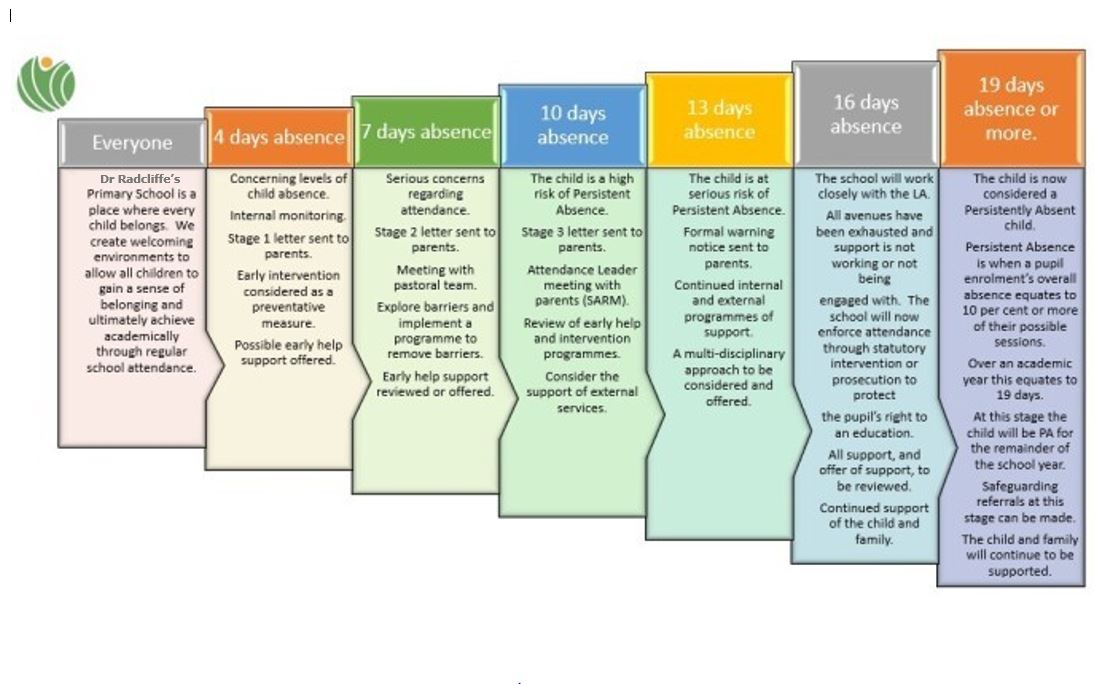
We adopt the 5 Foundations of Effective Attendance Practice framework. This is modelled on the work of Professor Katherine Weare. The emphasis is on developing a school culture and climate which builds a sense of connectedness and belonging to ensure all children can attend school and thrive. The approach ensures we prioritise building solid working relationships with children and parents prior to any escalation.
The staged approach we use ensures we identify triggers early that can lead to poor attendance issues such as; mental health issues, lack of trust, communication and lack of support networks both in and out of school and from external professionals.
 Aims of the strategy
- Increase school attendance and reduce persistent absence to meet set targets.
- Ensure attendance is well managed within the school, with the appropriate level of resources allocated.
- Enable the school to make informed use of attendance data to target interventions appropriately, focusing on the key demographic groups highlighted in the 2022 DFE paper.
Objectives
- Create an ethos within the school in which good attendance is recognised as the norm and every child aims for excellent attendance.
- Make attendance and punctuality a priority.
- Set focused targets to improve individual attendance and whole school attendance levels.
- Embed the 5 Foundations of Effective Attendance Practice framework which defines agreed roles and responsibilities and promotes consistency in carrying out designated tasks with respect to promoting attendance and punctuality.
- Record and monitor attendance and absenteeism and apply appropriate strategies to minimise absenteeism.
- Develop a systematic approach to gathering and analysing relevant attendance data provide support, advice and guidance to; parents, children and young people and develop mutual cooperation between home and the school in encouraging good attendance and in addressing identified attendance issues.
- Demonstrate through the use of rewards that the school recognises good attendance and punctuality are achievements in themselves.
The school has a fully embedded ethos in which excellent school attendance is expected, developed and nurtured. An escalated approach ensures the school has a deeply embedded and consistent whole school approach to improving attendance.
The approach to improving attendance is built on solid policies, systems and processes; this ensures sustainable and continuous improvement drives practice. Succession planning is built around an effective systems leadership model - rather than that of an individual attendance leader. The Attendance Policy drives school practice, it is deeply embedded in daily practice and ensures the school sets, and maintains, high expectations to improve the culture of attendance.
The school prioritises developing a fully engaged team of attendance experts, with a shared vision and core purpose. Through this development, the Attendance Leader will raise the status of attendance and ensure improved attendance is both sustained and continuous. CPD will support staff at all levels to fully understand their role in supporting attendance. The development of external partnerships will support attendance improvements through a multi-disciplinary approach for identified children and families.
Data information and analysis direct resources proactively towards key demographic groups and identified individuals. The expert use of data analysis informs decision making at all levels. A rigorous and effective attendance cycle ensures the attendance leader not only captures key information but also further understands the ‘deeper roots’ that create barriers regarding attendance to school.
Connecting and belonging drives the school approach to supporting attendance - this is deeply embedded in an evidence-based approach. The school has effective routines in place that are followed by staff. Staff at all levels within the school understand the 'deeper roots' regarding poor attendance and this is supported through a systematic approach. The school has developed, and embedded, an effective rewards system to further drive attendance improvements and celebrate success.
DFE: Working Together To Improve Attendance 2022.
From September 2022 the DFE: Working Together To Improve Attendance paper will replace all previous guidance on school attendance except for statutory guidance for parental responsibility measures. The Secretary of State has committed to it becoming statutory when parliamentary time allows (this will be no sooner than September 2023).
The table below identifies how the 5 Foundations of Effective Attendance Practice will underpin the DFE 2022 paper in meeting the summary of expectations.